
Oct 30, 2026
Forklift vs. Skid Steer Cost, Lifting Capacity, and Jobsite Productivity
A contractor adding a material handling machine to the fleet usually starts with a price comparison. That number is only the beginning. A forklift that costs less to buy can become the more expensive choice if it spends half the season stuck on soft ground.
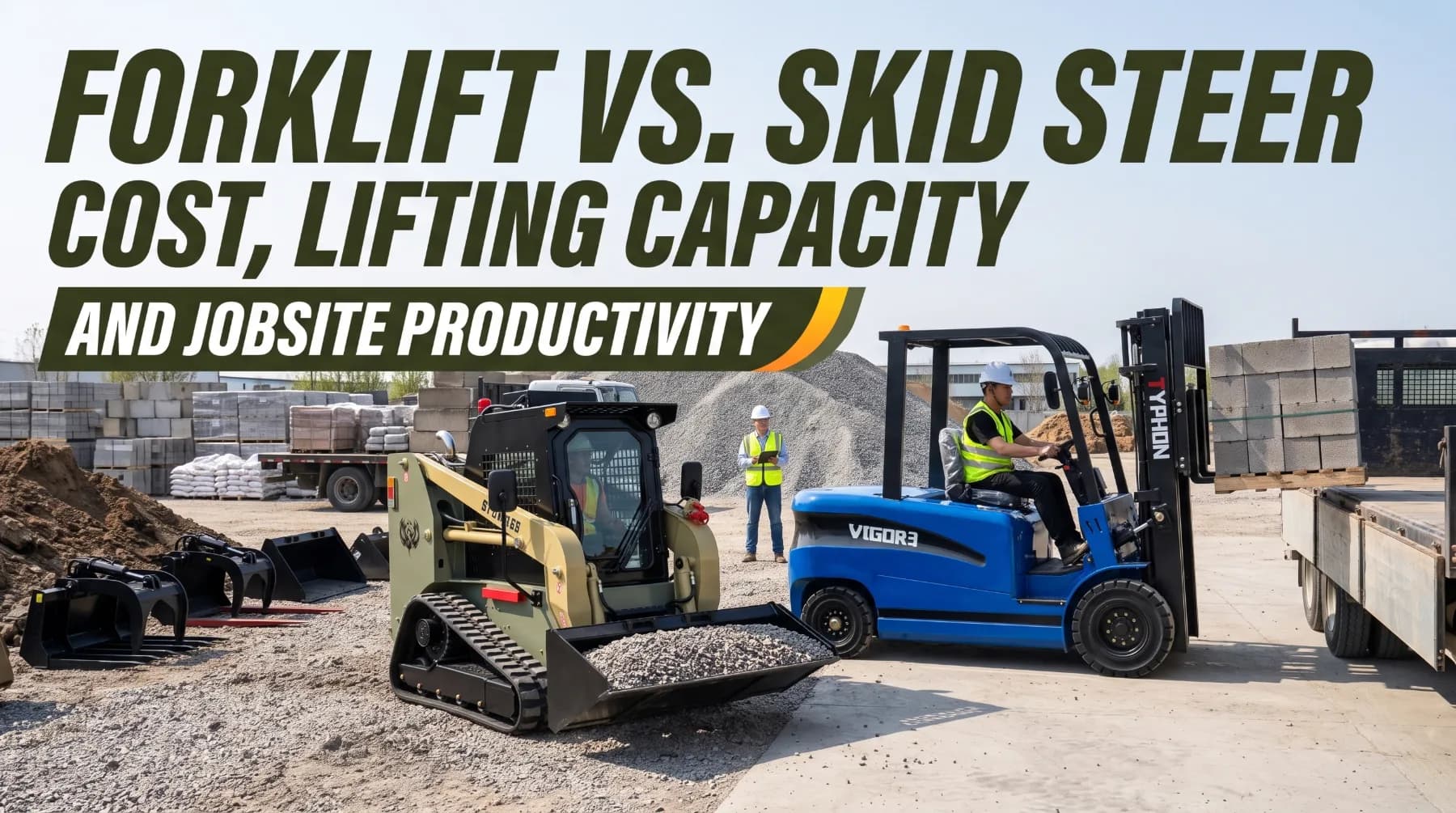
A contractor adding a material handling machine to the fleet usually starts with a price comparison. That number is only the beginning. A forklift that costs less to buy can become the more expensive choice if it spends half the season stuck on soft ground. A skid steer with an attractive price can cost more over time if it handles palletized loads too slowly for a busy distribution yard. The machine that delivers the best value is the one that completes your actual work efficiently, safely, and reliably year after year.
Forklifts and skid steer loaders both move material, but they are built around different priorities. A forklift is engineered to lift, carry, and position compatible loads, often at height and with precision. A skid steer loader supports a much broader range of ground-level tasks, including digging, grading, clearing debris, moving bulk material, and carrying pallets with approved forks. Those design differences shape what each machine costs to buy, what it costs to run, how much it can safely lift, and how productive it is on a given site.
Comparing the two machines fairly means looking past headline figures. Capacity ratings follow different methods. Operating costs depend on duty cycle, terrain, and power source. Productivity depends on how well the machine matches the task, not on how many tasks it can perform in theory. Evaluating each factor against your own workload leads to a far more dependable investment decision.
Purchase Price and Initial Investment
The purchase price of a forklift or skid steer varies widely. Model, rated capacity, power source, operating condition, and included equipment all affect the figure. A compact warehouse forklift and a high-capacity rough-terrain forklift sit at very different price points. The same is true for a small-frame skid steer and a large high-flow compact track loader.
Specialized configurations raise the initial investment. On a forklift, a taller mast, a sideshifter, fork positioners, or cold storage options all add cost. On a skid steer, an enclosed cab with heating and air conditioning, high-flow hydraulics, upgraded controls, or a track undercarriage can increase the price significantly. Attachments add further cost, and a skid steer's value often depends on owning several of them.
Compare machines with similar capabilities rather than relying on base prices alone. A lower-priced machine that lacks the lift height, capacity, or hydraulic flow your work requires will need upgrades later or will limit productivity from the first day. Build a like-for-like comparison using the specifications that matter to your operation.
The cost of putting a machine into service goes beyond the invoice. Factor in delivery, operator training, required safety equipment, and financing terms. Electric forklifts may require charging infrastructure, and some facilities need site modifications such as charging areas, ramps, or improved floor surfaces. Including these items from the start gives you a realistic picture of your initial investment.
Key takeaway: Purchase price depends on model, capacity, power source, condition, and equipment, so compare machines with similar capabilities and include delivery, training, safety equipment, financing, and site modifications in your initial investment.
Calculating Total Cost of Ownership
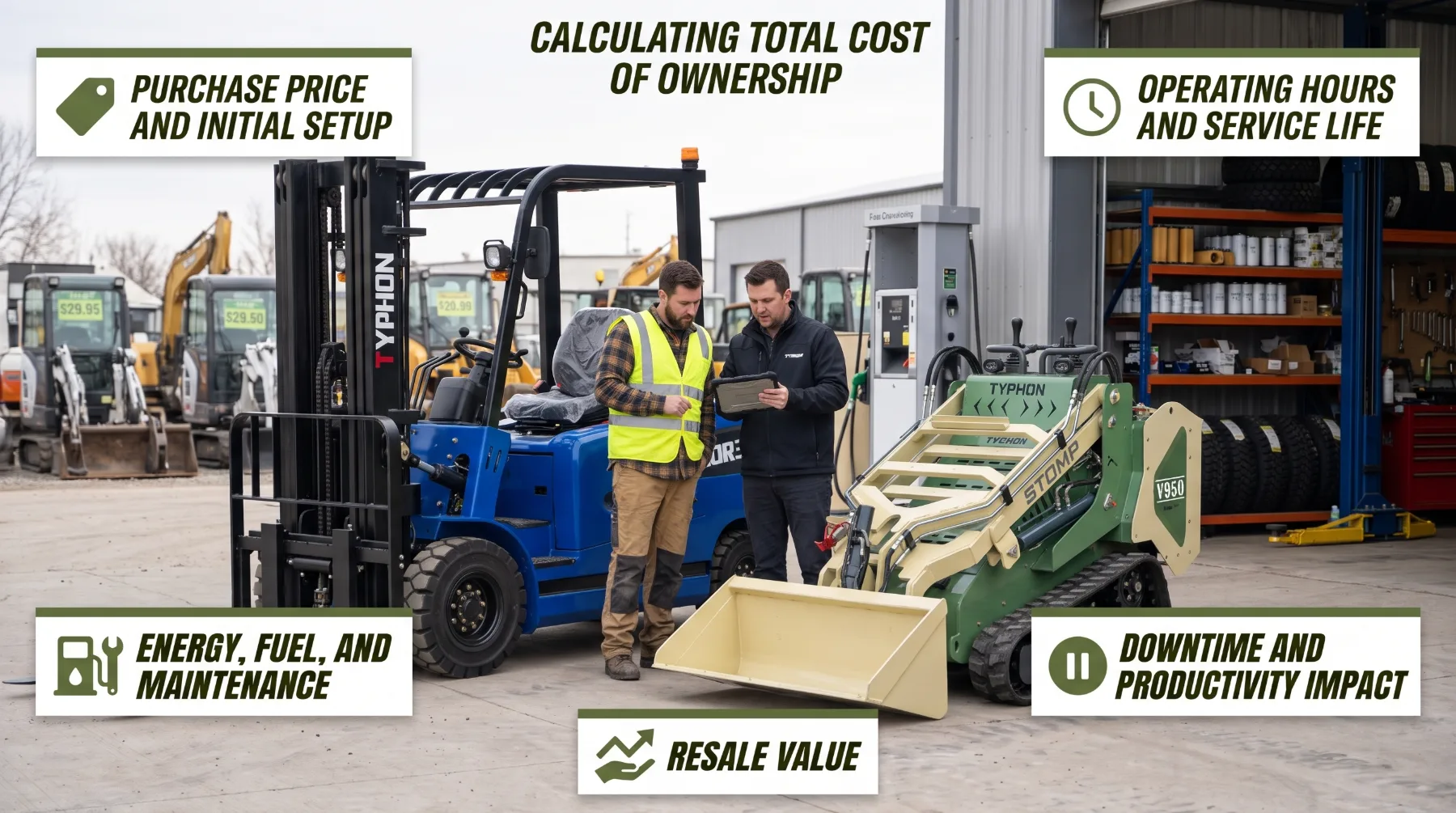
Total cost of ownership gives a far more accurate picture than purchase price alone. It accounts for every cost the machine generates over its working life and weighs them against the value it delivers. Build your comparison around these five factors.
-
Purchase Price and Initial Setup: Include the machine, required attachments, delivery, training, safety equipment, financing, and any site modifications such as charging areas.
-
Operating Hours and Service Life: Estimate annual operating hours and expected service life to spread costs accurately across the machine's working years.
-
Energy, Fuel, and Maintenance: Project fuel or electricity use, scheduled servicing, tires or tracks, wear parts, and likely repairs based on your duty cycle.
-
Downtime and Productivity Impact: Account for lost production during repairs, the availability of local service and parts, and how well the machine fits your daily workload.
-
Resale Value: Consider the machine's expected value at the end of your ownership period, which is influenced by condition, hours, brand support, and market demand.
Key takeaway: Calculate total cost of ownership by combining purchase and setup costs, operating hours and service life, energy and maintenance, downtime impact, and resale value, then weigh them against how well the machine fits your daily work.
Operating Costs and Routine Maintenance
Operating costs continue for as long as you own the machine. They include energy or fuel, scheduled maintenance, tires or tracks, wear parts, and repairs. Over several years, these costs often exceed the original purchase price, which makes them central to any serious comparison.
Power source has a major effect. Electric forklifts can suit facilities with regular indoor handling and appropriate charging arrangements. They typically have fewer engine-related service items, though batteries require careful charging practices and eventual replacement. Internal combustion forklifts powered by LPG, gasoline, or diesel may suit outdoor work, multi-shift operations without charging capacity, or rough-terrain applications.
Skid steer operating costs depend on engine type, duty cycle, terrain, and hydraulic attachment use. Running a mulcher, cold planer, or trencher for long periods increases fuel use, heat, and wear on hydraulic components. Abrasive ground accelerates wear on tires, tracks, bucket edges, and undercarriage parts. Compact track loaders can offer strong traction on soft ground, but track and undercarriage maintenance adds its own cost.
Fuel or energy consumption alone rarely tells the full story. Review expected operating hours, service intervals, and the manufacturer's maintenance requirements. Consider the price and availability of common wear parts in your area as well. A machine that is easy to service and well supported by a local dealer usually delivers lower operating costs over its life.
Key takeaway: Compare operating costs using expected hours, service intervals, wear parts, and repair needs rather than fuel or energy use alone, because power source, duty cycle, terrain, and attachments all shape long-term running costs.
Terrain and Material Handling Requirements
The right machine has to handle both the load and the ground it travels across. Forklifts excel at pallet movement, stacking, truck loading, and transporting compatible loads across surfaces suited to their design. In warehouses, distribution centers, and loading docks, they place loads accurately and repeat lift cycles efficiently.
Skid steer loaders are well suited to moving loose material, clearing debris, grading, and working across construction and landscaping sites. They load soil, carry aggregate, backfill trenches, and clean up work areas. With approved pallet forks, they can also move palletized material around a yard or site, though usually without the lift height or placement precision of a forklift.
Ground conditions affect both machines. Indoor forklifts with cushion or solid tires are built for smooth, level floors and are not suited to gravel, mud, or rutted ground. Rough-terrain forklifts use larger pneumatic tires and greater ground clearance for outdoor work. Wheeled skid steers perform well on firm surfaces, while compact track loaders may offer better traction on soft or uneven terrain. Mud, slopes, and loose soil still affect safe operation for every machine.
Match the machine to the actual travel surface and load type. Walk the route from pickup to placement and note soft areas, slopes, curbs, ramps, doorways, and overhead obstructions. A machine that suits the destination but cannot safely reach it will cost you time and create risk.
Key takeaway: Forklifts suit pallet handling, stacking, and truck loading on appropriate surfaces, while skid steers suit bulk material, grading, and site cleanup, so match each machine to the real travel route and load type.
Lifting Capacity and Rated Limits
Rated capacity defines what a machine can handle safely under specified conditions. It reflects the manufacturer's engineering of balance, structure, and hydraulics, and it must always be treated as a firm limit. Forklifts and skid steers express capacity in different ways, so their ratings cannot be compared directly.
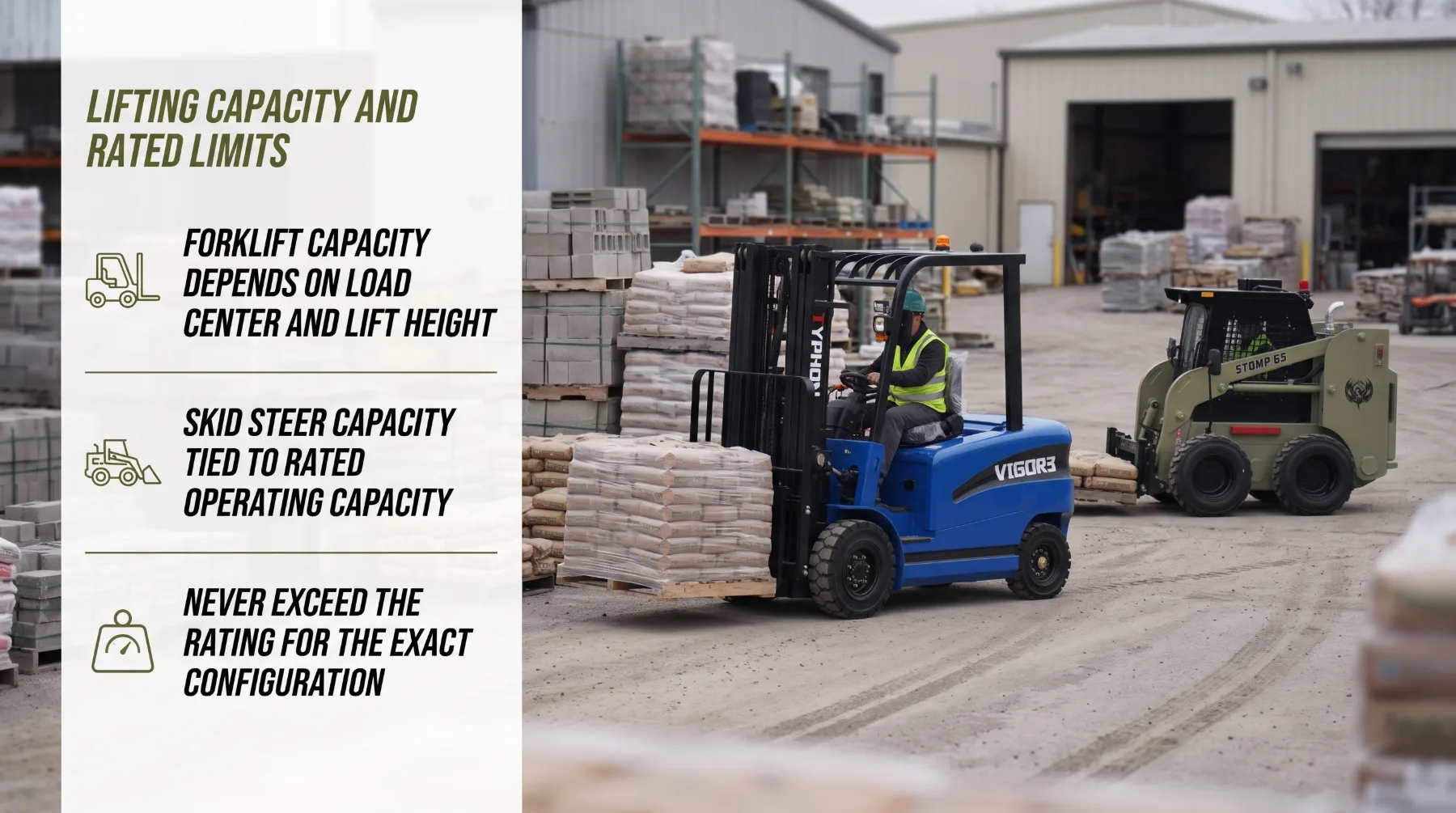
Forklift capacity depends on load center, lift height, mast configuration, and attachment. The load center is the horizontal distance from the fork face to the load's center of gravity. As that distance increases, the load creates more leverage against the counterweight and effective capacity falls. On many configurations, capacity also drops as the load is raised higher. The data plate states rated capacity at a specified load center and lift height, and it should reflect any installed attachment.
Skid steers are commonly assessed using rated operating capacity, which manufacturers set as a defined portion of the machine's tipping load. Load position matters here too. A pallet carried far out on the tines places more leverage on the machine than the same weight held close to the carriage. Lifting a heavy load high on uneven ground raises the center of gravity and reduces stability.
On both machines, attachment weight reduces the load that can be carried. Check the correct capacity information for the exact configuration you plan to use, and never exceed the manufacturer's permitted limits. A machine that can physically raise a load is not necessarily able to carry it safely.
Key takeaway: Forklift capacity depends on load center, lift height, mast, and attachment, while skid steer capacity is tied to rated operating capacity and tipping load, so use the correct rating for the exact configuration and never exceed it.
Productivity and Attachment Versatility
Productivity measures how effectively a machine completes the required work, not how many jobs it could perform in theory. A machine matched closely to a task will usually outperform a more versatile machine assigned to the same work.
Forklifts are highly efficient for repetitive pallet handling and elevated storage. In a warehouse or yard with constant loading, unloading, and racking, a forklift moves loads quickly, positions them precisely, and keeps cycle times short. Attachments such as sideshifters and fork positioners improve that efficiency further by reducing repositioning.
Skid steers earn their value through versatility. One machine can switch among compatible buckets, pallet forks, grapples, augers, trenchers, and sweepers to handle different site tasks across the day. For contractors whose work changes from job to job, that flexibility can reduce the number of machines they need to buy, transport, and maintain.
Real-world output depends on several factors. Attachment changeovers take time, travel distance affects cycle length, and operator skill shapes speed and accuracy. Load placement requirements and jobsite congestion matter as well. A machine that is versatile on paper may not be the fastest option for a specialized, repetitive task. Measure productivity against the work you perform most often.
Key takeaway: Forklifts deliver strong productivity for repetitive pallet handling and elevated storage, while skid steers add value through attachment versatility, so judge productivity by how efficiently each machine completes your most common tasks.
Conclusion
Forklifts and skid steer loaders offer distinct advantages in lifting, mobility, versatility, and operating cost, and neither machine is the universal cost winner. Purchase price depends on capacity, power source, configuration, and setup costs, so compare machines with similar capabilities. Operating costs reflect duty cycle, terrain, attachments, and service requirements more than fuel or energy use alone. Forklift and skid steer capacity ratings follow different methods and must always be checked for the exact configuration. Forklifts suit pallet handling, stacking, and elevated placement on appropriate surfaces, while skid steers suit bulk material, grading, and varied site work. Productivity comes from matching the machine to the task, and total cost of ownership brings every factor together into one reliable comparison.
Before you invest, list the loads and tasks your crews handle most often, walk your typical travel routes, and confirm the required lift height and rated capacity for every attachment. Then estimate annual operating hours, review local service and parts support, and calculate total cost of ownership for each option. Finally, arrange a demonstration with your own materials on representative ground so your decision reflects the long-term value the machine will deliver on your sites.
Frequently Asked Questions
Is a forklift cheaper to operate than a skid steer?
It depends on the model, power source, energy or fuel costs, workload, maintenance needs, and operating environment. An electric forklift working indoors may have low running costs, while a skid steer running hydraulic attachments on abrasive ground may cost more to operate. Compare costs over the expected service life rather than by the hour alone.
Which machine has the higher lifting capacity?
There is no universal answer. Capacity depends on the individual model and configuration. Forklift ratings are based on load center and lift height, while skid steers use rated operating capacity tied to tipping load, so the figures cannot be compared directly.
Which machine is better for a construction site?
A skid steer may suit digging, grading, debris cleanup, and bulk material handling across a changing site. A forklift, particularly a rough-terrain model, may be better for unloading palletized materials and placing them at height. Many construction operations benefit from using both machines for separate tasks.
How can businesses compare jobsite productivity?
Measure completed tasks per hour, travel time, load requirements, attachment changeovers, downtime, and operator needs for the specific work. A side-by-side demonstration on representative ground with your own materials provides the clearest comparison.